

Background
Pyramid of Senusret II
at El Lahun, Faiyum Egypt
In the Faiyum region, south of Cairo, the remains of at least 4 pyramids can still be seen today. Traditionally attributed to middle kingdom, the pyramid of Senusret II is said to have been built during the 12th dynasty. Originally cased in limestone, the pyramid was quarried up until recent times

Sir Flinders Petrie recorded the remnants of limestone casing blocks as late as the 1890s. The exposed mudbrick exterior visible today was once an interior layer of unknown purpose. Now at the mercy of desert winds and periodic rainfall, its decomposition is all but inevitable.
At the center of this pyramid is a structural frame of megalithic limestone blocks, visibly protruding from underneath the mudbrick.
But what lies below the base of the pyramid is some of the most impressive stone work on earth - and the subject of our study.
In 1891, Sir Flinders Petrie documented the passages below the base of the pyramid that were known at the time. His sketch (right) demonstrates that while not connected to the above ground structure, the subterranean passageways lead to a centrally located chamber.
The pitched roof chamber (circled on right) is a striking room made of red granite with a very special red granite box located inside.


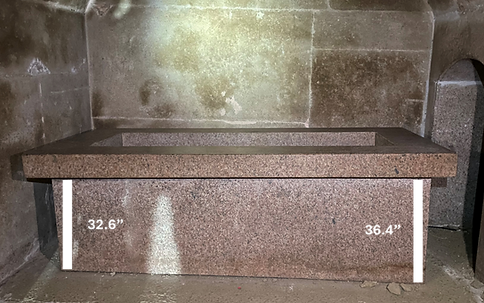
The object can be described as an open rectangular prism. Its 4 interior and exterior sides meet at right angles. The interior bottom is flat (exterior bottom is inaccessible) and no cover or lid is known to exist, at least not since the chamber was rediscovered in the late 19th century.
The curiously offcut base seems at odds with the geometric precision of the rest of the object, and indeed the room itself. The left and right underside heights are nearly 4 inches different. The reason behind this curious design remains a mystery.

Sir Flinders Petrie measured the box extensively. He determined the flatness of the top edge (length wise) to be 0.007 inch across 106.12 inches in length. The flatness of the width (highlighted on left) was measured to be 0.004 inch across 50.05 inches.
"This is one of the greatest triumphs of accurate work in such a material that has ever been done" - Petrie 1920
Analysis & Results
Using portable laser scanning technology, we mapped the interior and exterior surfaces of the box.
The flatness of all interior and exterior surfaces is truly remarkable. While the exact methodology used by Sir Flinders Petrie is unknown, in some areas the surface deviation is below 0.001 inches.
